I haven't written anything on this blog in years. This, I write for my Baba. But where do I start? I don’t know how to neatly pack into a blog post a man as interesting and expansive as him. I could start by telling you that he’s not with us anymore, that he died on the last day of February this year, and that as of today we’ve been without him for three months—but that would not be true. He’s with me every day. He’s here right now, reading this over my shoulder, making sure the spellings and punctuation are in order. He’s not there in his physical body, but the shape of him is everywhere. Which is not enough, not nearly enough.
I miss his hugs. There were always hugs—even in our hardest times, especially in our hardest times—our home was never short on good, solid hugging. Both Baba and Ma. I come from parents who’re huggers. Baba’s hugs were unhurried, arms wrapping me close, the smell and feel of him cool, fresh, even on the warmest days, I don’t know how.
I miss his voice. So full of life! He didn’t just greet people, he greeted people, his voice rising, smile widening, eyes warm with pleasure that someone had called or that he’d bumped into them on his way to the bank, the post-office, the bazaar. Which seemed inexplicable to the teenaged me, who wanted only to walk down the driveway of our multistoried building without bumping into anyone. A building of 96 flats where Baba knew everyone, and not just the residents. The security guards, the drivers, cleaners, lift-man, the vegetable-wala; he didn’t just know them by name, he knew their lives. After he passed, for weeks and weeks the doorbell rang every other hour and the house filled up with people who simply wanted to talk to us about him, share stories, tell us of conversations they’d had with Baba that had meant something to them, things that he’d done to help, or simply make them laugh, make their day a little more interesting.

An interesting person, that’s what he was; still is, wherever he is. Maybe it had something to do with the fact that he was the youngest of ten children—that position in a household makes you work harder at being visible, being heard; it also inclines you to observe and be interested in the lives of others. He knew how to invite and hold the attention of those around him, and he did it by sharing stories. Goppo, as he’d say. He was a storyteller—though his stories, unlike mine, were planted in fact rather than fiction. His tellings were as unhurried as his hugs, his anecdotes pitched to perfection, his recounting of history, whether political or literary, liberally laced with humour, with quotes and excerpts of speeches and letters that had been rendered to memory. He knew how to work the room.
This attention was not just something he was good at getting, but also good at giving. If I were to think of the best thing Baba ever gave us—me and my brother, and later D, when I met and married him—was his attention, his time. I sit here now, writing this, held by all the hours he gave to me.
Baba teaching me yoga. Showing me how to keep my spine supple and breath slow, telling me what each asana was for (what a chore it seemed to me then, and how thankful my body and mind is for it now!). Baba leaving a notebook on the table every afternoon, three-four pages of mathematical problems he’d written for me to solve, which he’d later sit with me to check and explain. Baba helping me through my panicked last-minute cramming before every exam, because I was forever a last-minute crammer who refused to learn her lesson. Baba underlining a passage in his favourite weekly column—Manohar Malgonkar’s in The Statesman—to show me the beauty and precision of a sentence. Baba reminding me to drink my water sitting down, read my book in better light, keep my head covered when it rained.
With all the stresses and concerns life threw at him, how did he make himself so available? So present to us? How did each of us feel like we had his undivided attention? because when I sat with him, his world shrank to me. He always wanted to know everything about my day—my work, the ad campaign or brand I was working on, how I’d thought of an idea. When I started writing fiction, he read everything I wrote, every piece ever published. And despite my protests, and later strict injunctions, continued to make photocopies of my stories and essays to hand out to anyone who professed to be a reader.
My brother and I grew up with this: Baba’s time and attention. And in equal measure his annoyance and anger and exasperation and all that comes with care, with giving a damn. This care that costs nothing and is the most expensive thing in the world.

He often talked about the care he received from his own parents—of his father writing essays for him, his mother saving him a piece of fish. He came from a large family of spare means, but care was something he’d known and passed on. Baba was young, around ten years old, when his parents were forced to leave their home in Dhaka’s Narayangunj and flee to Calcutta during the Partition. In the middle of the night. In the middle of riots—the horrific sights of which he never forgot—with only as much as they could carry. He did not have the easiest of childhoods or youth, but those years gave him a kind of resourcefulness and resilience and courage I’ve seen in very few people: he knew how to adjust and bounce back, how to turn Nos into Yeses; he believed change was possible at any age. In his mid-40s, when his friends were settled in their jobs and lives, he started studying, started from scratch because he did not find his work fulfilling, and took himself into uncharted territory. A few years after D and I married, D sought to make a similar change and return to studying. It wouldn’t be easy, everyone voiced their doubts—why rock the boat when things are fine? Today, what D remembers most, and still talks about, is Baba’s steadfast encouragement, his unblinking faith in our decision during those years of utter flux.
Even when we moved out of Calcutta, and eventually out of the country, Baba’s presence in our lives remained loud and clear. As loud as that sharp exclamation of joy, Ahh! aamar chotto-ma! whenever I called. Which in the last few years was everyday, often more than once, when we’d talk about nothing and everything: his walk and who he’d met (he was a come-rain-or-shine walker), his plans and engagements for the week (my parents’ social life was far busier than ours). Sometimes he called to report that he’d finished a set of exercises I asked him to do (because from Baba teaching me yoga, to me teaching him calisthenics, life had come full circle), or to give me a review of the food I’d Swiggy-ed to them. Sometimes, he’d call to read out something interesting to me or to D, depending on whose interest it aligned with. Often, he’d call because he wanted my opinion on something that was occupying his mind—that trust, I hold very close to my heart.
Once he’d gotten used to video-calls, audio-calls just didn’t cut it; he had to see our faces. If for some reason a video-call wasn’t possible, his voice would droop, No point then, he’d say, even if it was only to talk about what we ate for lunch. Because for him, no conversation was an ‘only’ anything. So what did you put in the salad? he wanted to know; never mind that his relationship with a kitchen began and ended with a pot of tea (he claimed to be able to make an omelette, but it remains largely legend). He’d repeat the ingredients of my salad like it was information of the greatest usefulness: Broccoli. Parmigiano. Par-mi-jano? Okay. Olive oil—very healthy. Balsamic? Bal-sa-mic. I don’t know how you remember these names. And egg, good. No toast on the side? He repeated words and information unfamiliar to him—unknown ingredients, new technologies, a new author I was reading—repeated them four, five times, and later checked back to see if he’d remembered it right.
.jpg)
It’s this incredible curiosity—a curiosity that stayed until the very end of his earthbound days—that made him so expansive. Made his life not just long, but large. And loved. And it is this curiosity, this energy, that makes me sense him now, reading this over my shoulder, so that I have to remind myself that he’s not back home reading his newspaper. Or doing his pranayam. Or standing at the window staring intently at trees because it's good for the eyes. That he’s moved away a little, like we did years ago. He’s moved out of his city, out of the country of his body, but is no less present to us who love him.
:::
DR. TARUN KUMAR GHOSH
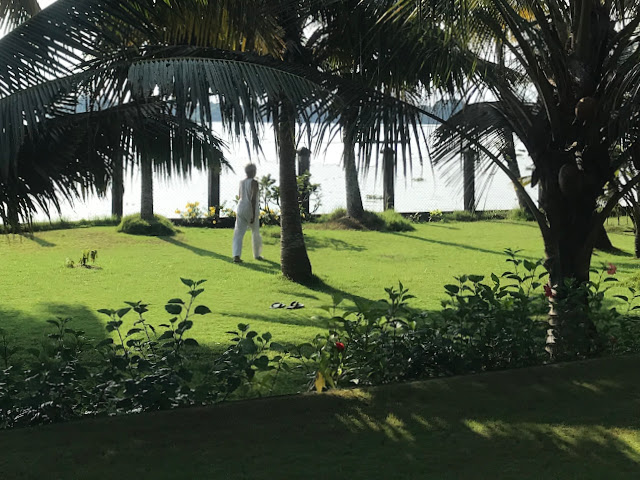
who loved to look at the water and walk barefoot in the grass
and who never said no to ice-cream
1937 — 2023
& on
:::